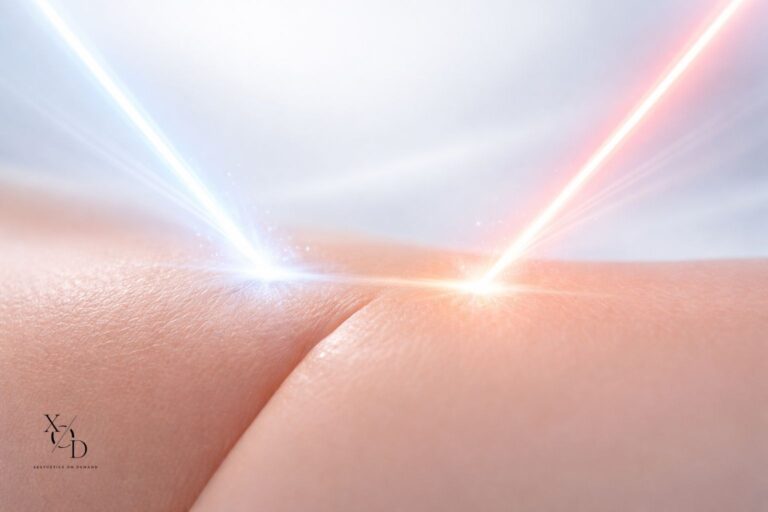
The wavelength debate in laser hair removal comes down to two dominant technologies: diode lasers operating at 808nm and Nd:YAG systems at 1064nm.
Each wavelength brings distinct advantages for specific patient profiles, treatment scenarios, and practice models.
Understanding these differences helps you invest wisely and deliver optimal outcomes across your patient population.
The Science of Wavelength Selection
Laser hair removal works through selective photothermolysis – using light energy to heat and destroy hair follicles while sparing surrounding tissue.
The wavelength determines how that light interacts with skin and hair.
808nm Diode Laser
The diode wavelength sits in the optimal absorption range for melanin in the hair follicle.
It penetrates approximately 3-4mm into tissue – deep enough to reach the follicular bulb in most body areas.
Strong melanin absorption means efficient energy transfer to pigmented hair.
1064nm Nd:YAG Laser
The longer wavelength penetrates deeper (5-7mm) and absorbs less into epidermal melanin.
This reduced surface absorption makes Nd:YAG the safest choice for darker skin types.
The tradeoff: lower melanin absorption requires higher fluences to achieve follicular destruction.
Patient Selection by Skin Type
Fitzpatrick I-III (Light Skin)
Diode lasers excel on lighter skin types.
The strong melanin absorption translates to efficient treatments at moderate fluences.
Patients experience faster sessions, often with superior comfort due to lower energy requirements.
For practices serving predominantly Caucasian populations, diode technology delivers excellent results with straightforward protocols.
Fitzpatrick IV (Olive/Light Brown Skin)
This transitional skin type benefits from either wavelength with proper parameter selection.
Diode remains effective but requires more conservative settings – longer pulse durations and moderate fluences.
Nd:YAG provides an extra safety margin without sacrificing efficacy.
Experienced practitioners often achieve comparable results with either technology in this skin type range.
Fitzpatrick V-VI (Brown to Dark Skin)
Nd:YAG becomes essential for safe treatment.
The 1064nm wavelength bypasses most epidermal melanin, dramatically reducing burn and hyperpigmentation risks.
Attempting diode treatment on darker skin types invites complications – post-inflammatory hyperpigmentation, burns, and scarring.
If your practice serves diverse communities, Nd:YAG capability is non-negotiable for comprehensive hair removal services.
Hair Characteristics and Treatment Response
Coarse, Dark Hair
Both wavelengths perform well on the ideal hair removal candidate – thick, dark terminal hair with strong melanin content.
Diode often achieves slightly faster clearance rates due to higher melanin absorption.
Nd:YAG requires more sessions but delivers reliable results.
Fine Hair
Diode lasers struggle with fine, light hair.
The reduced melanin content limits energy absorption, requiring higher fluences that increase side effect risks.
Nd:YAG’s deeper penetration and different absorption profile can sometimes address finer hair more effectively, though neither wavelength excels in this scenario.
Blonde, gray, and red hair remain challenging for both technologies.
Body Area Considerations
Face and neck: Both wavelengths work well. Diode’s efficiency makes it popular for smaller areas. Nd:YAG’s safety profile appeals for treating darker-skinned patients in visible areas.
Back and chest (men): Large areas favor faster treatment times. Modern high-powered diode systems with large spot sizes clear these areas efficiently.
Bikini and underarms: Coarse hair responds excellently to both wavelengths. Patient comfort varies – some prefer the diode’s faster passes, others find Nd:YAG’s cooling systems more comfortable.
Legs: Large surface area makes treatment speed important. Both technologies handle leg hair effectively with appropriate spot sizes and repetition rates.
Treatment Parameters and Protocols
Diode Laser Settings
Typical parameters for 808nm diode:
- Fluence: 20-40 J/cm² (adjusted by skin type)
- Pulse duration: 30-100ms
- Spot size: 9-12mm common
- Repetition rate: 1-3 Hz
Lower fluences and longer pulse durations for darker skin types.
Higher fluences possible on very light skin with dark hair.
Nd:YAG Laser Settings
Typical parameters for 1064nm Nd:YAG:
- Fluence: 30-50 J/cm² (higher due to lower absorption)
- Pulse duration: 20-50ms
- Spot size: 10-18mm available
- Repetition rate: 1-2 Hz
The higher fluence requirements mean treatments often take longer than equivalent diode sessions.
Proper cooling between pulses becomes critical for patient comfort.
Treatment Outcomes Comparison
Number of Sessions
Clinical studies generally show:
- Diode (light skin, dark hair): 6-8 sessions for 80%+ reduction
- Nd:YAG (any skin type): 8-10 sessions for comparable results
The session differential reflects the absorption efficiency difference between wavelengths.
Permanence of Results
Both wavelengths achieve permanent hair reduction when proper parameters target the follicle during anagen (growth) phase.
Long-term studies show comparable permanence between technologies when treatment protocols match patient characteristics.
Side Effect Profiles
Diode risks:
- Epidermal burns (especially on tanned or darker skin)
- Blistering with excessive fluence
- Post-inflammatory hyperpigmentation
- Paradoxical hypertrichosis (rare)
Nd:YAG risks:
- Generally lower side effect rates
- Deep tissue heating if parameters excessive
- Longer recovery from any adverse events due to deeper penetration
- Paradoxical hypertrichosis (rare)
The safety differential makes Nd:YAG the conservative choice when patient skin type assessment proves uncertain.
Business Considerations
Equipment Investment
Standalone diode systems typically cost $40,000-80,000.
Nd:YAG platforms range from $50,000-120,000 depending on features.
Combination platforms offering multiple wavelengths (often 755nm alexandrite + 1064nm Nd:YAG, or triple-wavelength diode systems) represent premium investments but maximum versatility.
Treatment Pricing
Market rates remain comparable between wavelengths – patients care about results, not the specific technology.
Practices emphasizing safety for all skin types can sometimes command premium pricing for Nd:YAG treatments marketed specifically to darker-skinned patients underserved by competitors limited to diode-only systems.
Practice Positioning
Diode-focused practice: Works well in predominantly light-skinned markets. Lower equipment costs may enable competitive pricing. Efficient treatments support high-volume models.
Nd:YAG-focused practice: Differentiates in diverse markets. Safety messaging resonates with darker-skinned patients burned (literally) by inappropriate previous treatments elsewhere. Positions practice as clinically sophisticated.
Dual-wavelength practice: Maximum flexibility. Higher investment but broadest market reach. Optimal patient matching to appropriate technology.
The Triple-Wavelength Solution
Modern aesthetic platforms increasingly combine 755nm (alexandrite), 808nm (diode), and 1064nm (Nd:YAG) wavelengths in single systems.
This approach lets practitioners match wavelength to patient characteristics rather than forcing patients into whatever technology the practice owns.
Triple-wavelength systems also enable wavelength blending – treating mixed hair and skin presentations with sequential passes at different wavelengths within a single session.
The investment premium pays dividends in treatment flexibility and patient satisfaction.
The Right Technology for Your Practice
The choice between diode and Nd:YAG ultimately depends on your patient demographics, treatment volume goals, and business model.
For practices focused on efficiency and serving lighter skin types, a dedicated portable diode laser like DIOGO delivers exceptional results with true mobility – weighing just 19 lbs with built-in sapphire cooling and VCSEL technology for uniform energy distribution.
For practices serving diverse populations or wanting maximum flexibility, ZELUSSO offers interchangeable handpieces including:
- Diode laser (808nm or triple-wavelength 760-808-1060nm)
- Nd:YAG (Long Pulse and Q-Switch)
- IPL for pigmentation and vascular concerns
This expandable platform lets you match the right wavelength to each patient without investing in multiple standalone systems.
Both approaches enable the mobile hair removal services that increasingly differentiate successful aesthetic practices.
Ready to explore portable laser solutions? View our device lineup or schedule a demo to see the technology in action.